Towards Brain MRI Adaptable to Head Size: Bowing RF Coil Phased Arrays
Mathieu, W., Popovich, M., and Farivar, R.
,
IEEE JOURNAL OF ELECTROMAGNETICS, RF, AND MICROWAVES IN MEDICINE AND BIOLOGY
,
2022
@article{mathieu2022towards,
title={Towards Brain MRI Adaptable to Head Size: Bowing RF Coil Phased Arrays},
author={Mathieu, William and Popovi{\’c}, Milica and Farivar, Reza},
journal={IEEE Journal of Electromagnetics, RF and Microwaves in Medicine and Biology},
volume={6},
number={3},
pages={305–310},
year={2022},
publisher={IEEE},
doi={10.1109/JERM.2021.3136090}
}
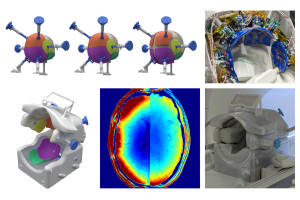
Bowing phased arrays allow for the idea of hybrid rigid-flexible RF coils, in which parts of a larger phased array are broken up into rigid sub-arrays, connected by flexible coil elements, permitting coils to expend or shrink to match different human head sizes. Methods: two arrays were constructed, a conventional rigid array used as a control and an array composed of flexible bowing elements. Bowing elements comprise of a flexible half and a rigid half. The arrays were then supported on translating boards connected so that a flexible gap between the boards corresponds to the bowing elements. The gap between the rigid coil elements was varied by discrete values to assess its performance under different bowing conditions. Results: signal-to-noise-ratio (SNR) and noise performance was compared between the two arrays. It is seen that a bowing array outperforms its rigid counterpart in terms of average SNR, max SNR, and signal coverage. We conclude that bowing array elements present a viable solution to the proposed hybrid rigid-flexible coil arrays.
Plain Language Summary